Sunday, August 24, 2008

Overview Of Medjugorje


Medjugorje

--------------------------------------------------------------------------------

History. On June 24, 1981, six children in the town of Medjugorje, Yugoslavia (today, Bosnia-Herzegovina), began to experience phenomena which they alleged to be apparitions of the Blessed Virgin Mary. This apparition had a message of peace for the world, as well as a call to conversion, prayer and fasting. It also entrusted to the children secret messages about events to be fulfilled in the future. These "secrets," confided individually to different visionaries, have not been revealed to the public. The apparitions themselves have continued almost daily since 1981, with some of the now young adults continuing to experience them regularly (those who have not yet received all the secrets intended for them) and others not. Originally they occurred on a hilltop near the town where a large Cross commemorating the Redemption exists. They have since occurred in many other places, including the parish church, St. James, and wherever the visionaries happen to be located at the time of the apparition.

The news that Our Lady might be appearing immediately began to attract pilgrims to Medjugorje, first from the surrounding countryside, and then, despite the communist government of that day, from Europe and the whole world. These included clergy and theologians, as well as experts from the physical and medical sciences who testified to some kind of phenomenon taking place when the apparition was said to be occurring. The private judgement of these early visitors did much to bolster people's belief in the events at Medjugorje. In addition, some pilgrims reported seeing the sun spin and being able to look at it without pain or eye damage, others that their rosaries turned gold colored, still others that remarkable physical or spiritual/moral healings had taken place. All of these contributed to the fame of the alleged apparition.


Ecclesiastical Evaluation. The initial, informal, response of the Bishop Zanic of Mostar, in whose diocese Medjugorje is found, is said to have been favorable. However, it is alleged that comments attributed to the vision that was critical of the secular clergy and himself convinced him the visions could not be authentic. He nonetheless established a commission in 1982, comprised of theologians, scientific experts and religious superiors to investigate the Medjugorje events. Its three year study produced a vote from two members of the commission in favor of supernaturality, one that it was authentic initially but no longer so, one abstention and eleven votes that nothing supernatural was occurring there. Letter of Bishop Zanic

Since the Medjugorje events had exceeded the scope of a local event, Cardinal Kuharic, President of the Yugoslavian Bishops Conference, announced in January 1987 that a national commission would be established to continue investigating. This decision had been communicated to the Holy See, which stated that it accepted the judgment of the diocesan commission under the authority of the local bishop but urged, as well, that the work be continued at the national level. The Bishops' Conference's instructions to the faithful were that pilgrimages should not be organized to Medjugorje on the basis of its being supernatural and that the Marian devotion of Catholics should be in accordance with Church teaching.
In April 1991 the following declaration was made by the Bishops' Conference of the former Yugoslavia:

The bishops, from the very beginning, have been following the events of Medjugorje through the Bishop of the diocese [Mostar], the Bishop's Commission and the Commission of the Bishops Conference of Yugoslavia on Medjugorje.

On the basis of the investigations so far it can not be affirmed that one is dealing with supernatural apparitions and revelations. [emphasis added]

However, the numerous gatherings of the faithful from different parts of the world, who come to Medjugorje, prompted both by motives of belief and various other motives, require the attention and pastoral care in the first place of the diocesan bishop and with him of the other bishops also, so that in Medjugorje and in everything connected with it a healthy devotion to the Blessed Virgin Mary may be promoted in accordance with the teaching of the Church.

For this purpose the bishops will issue specially suitable liturgical-pastoral directives. Likewise, through their Commission they will continue to keep up with and investigate the entire event in Medjugorje.

From the point of view of an ecclesiastical evaluation the status of Medjugorje has not changed since this 1991 declaration. The Holy See has allowed this status to remain as it is. Responding to bishops on the matter it simply repeats the aforementioned decision. However, a response from the Secretary of the Doctrinal Congregation, Archbishop Bertone, to a French bishop in 1996 precipitated a flurry of reports that Medjugorje was off-limits to Catholics. In August 1996 the Director of the Holy See's Press Office, Dr. Joaquin Navarro-Valls, stated:

You cannot say people cannot go there until it has been proven false. This has not been said, so anyone can go if they want.

...When one reads what Archbishop Bertone wrote, one could get the impression that from now on everything is forbidden, no possibility [for Catholics to travel to Medjugorje] ... nothing has changed, nothing new has been said.

...The problem is if you systematically organize pilgrimages, organize them with the bishop and the Church, you are giving a canonical sanction to the facts of Medjugorje. This is different from people going in a group who bring a priest with them in order to go to confession.

...Has the church or the Vatican said no [to Catholics visiting Medjugorje]? NO. ... The difference, in the terms of canon law, is that an official pilgrimage, organized by the diocese with the bishop, is a way of giving a juridical sanction to the facts; you are saying this is true. News Report.

More recently in a letter to the Bishop of St. Denis, Archbishop Bertone commented on a statement by the current Bishop of Mostar that the alleged apparitions were not simply lacking evidence of supernaturality but were in fact NOT supernatural (i.e. definitively so). He stated:

The main thing I would like to point out is that the Holy See does not ordinarily take a position of its own regarding supposed supernatural phenomena as a court of first instance. As for the credibility of the "apparitions" in question, this Dicastery respects what was decided by the bishops of the former Yugoslavia in the Declaration of Zadar, April 10, 1991: "On the basis of the investigations so far, it can not be affirmed that one is dealing with supernatural apparitions and revelations." Since the division of Yugoslavia into different independent nations it would now pertain to the members of the Episcopal Conference of Bosnia-Herzegovina to eventually reopen the examination of this case, and to make any new pronouncements that might be called for.

What Bishop Peric said in his letter to the Secretary General of FamilleChretienne, declaring: "My conviction and my position is not only non constat de supernaturalitate, but likewise, constat de non supernaturalitate of the apparitions or revelations in Medjugorje", should be considered the expression of the personal conviction of the Bishop of Mostar which he has the right to express as Ordinary of the place, but which is and remains his personal opinion.

Finally, as regards pilgrimages to Medjugorje, which are conducted privately, this Congregation points out that they are permitted on condition that they are not regarded as an authentication of events still taking place and which still call for an examination by the Church. Letter to Bishop Aubrey


Mystical Phenomena. The presence of remarkable phenomena is for many sufficient evidence of the validity of an alleged apparition. For others the judgment by local Church authority that there is no evidence of supernaturality at a site suggests fraud, mental illness or the demonic. The Church for her part, however, takes great care before affirming the certain supernaturality or non-supernaturality of phenomena, as the Roman statements given above show. There are likewise few examples of outright condemnation. When they do occur it is usually on the basis of doctrine which is contrary to the faith.

The reasons for such caution are rooted in the Church's common teaching. St. Thomas Aquinas and St. John of the Cross both assert that as a general rule mystical phenomena (whether in the lives of saints or in apparitions) are the work of the angels. Unless God Himself needs to act to immediately produce an effect (such as to create out of nothing or to infuse sanctifying grace into the soul), He works through creaturely instruments. Thus the intellectual lights granted in contemplative prayer, the visions and locutions of private revelations, the levitations of the saints, the ecstasies of mystics and visionaries, and most external phenomena associated with mysticism, are produced by the angelic nature. Since both good and evil spirits possess the angelic nature the presence of such phenomena alone is an equivocal sign of authenticity. This means that a great deal of unexplained phenomena can occur without indicating positively that the event is from God. This is why the Church looks, among other things, for evident supernaturality, that is, for effects beyond the ability of men or angels which can be attributed to God alone.

Theologians remain divided in judging which phenomena fall clearly into the category of strict supernaturality. However, the practice of the Church in the canonization process of recognizing as miraculous those cures which meet certain strict criteria is a standard that has been applied in approving apparitions, as well (e.g. Lourdes, Beauraing, Banneux). At Fátima the Miracle of Sun likewise fell into the category of a natural prodigy. It is clear, however, that the phenomena which many laity have experienced in connection with alleged apparitions in our days, and which they consider to be proof that they are authentic, do not in fact rise to the level of evident supernaturality. Angelic or demonic activity would be sufficient to explain them. Without a proof of the supernatural order there is little likelihood of the Church affirming an apparition as authentic.

In the case of Medjugorje the commissions found that nothing directly connected with the apparition met this strict standard. As the earlier quoted statements show, the Church remains open to new evidence of supernaturality should it occur and has not judged that Medjugorje is NOT supernatural, much less condemned it.


What the Church has forbidden. From the statements given to date by ecclesiastical authorities it is clear that no one holding an office in the Church (bishop, pastor, rector, chaplain or other) may by virtue of that office lend official sanction to activities which tend to assert the supernaturality of Medjugorje, that is, to contradict the decisions made by competent local authority. Those statements speak only of pilgrimages organized under official auspices; however, common sense tells us that a conference or other activity sponsored by a diocese, parish or other Catholic institution would also be prohibited. Likewise, there could not be public veneration (cultus) of the Blessed Virgin under the title of Our Lady of Medjugorje, since this would suggest the certainty of her appearing there. The title Queen of Peace, however, is already part of the patrimony of the Church.
The Yugoslavian statement speaks of liturgical-pastoral directives which may be developed. Catholics would be obliged to obey whatever positive or negative directives the Bishops' Conference or the local bishop issued regarding the site.

Do the decisions of the Church amount to an obligation to believe in the intellect that Medjugorje is not supernatural? The answer is no. First, even private revelations approved by Rome bind the faithful to accept them only based upon reasonableness, not faith. Pope Benedict XIV stated,
Although an assent of Catholic faith may not be given to revelations thus approved, still, an assent of human faith, made according to the rules of prudence, is due them; for according to these rules such revelations are probable and worthy of pious credence. [Benedict XIV, De Serv. Dei Beatif.]

This means that once a private revelation has achieved Papal approbation it is unreasonable, i.e. imprudent but not against the faith, to not accept it as authentic. The contrary would also be true. If Rome judged a private revelation to not be supernatural, the reasonable person would be satisfied with that conclusion. Would they sin if they did not accept it? They might sin by imprudence, rash judgement or the like, but not against the faith or the obedience they owed the Holy Father. Catholics must always, however, following the external precepts imposed by the Church in such matters, that is, what they may or may not do, as opposed to what they think.

As far as theological judgements made at the local level, therefore, the standard could not be any higher, and is certainly lower. The issue of Medjugorje, therefore, cannot be resolved solely on the basis of the local Church's finding that there is no evidence to date of supernaturality. This is even more clear in light of the statement of Archbishop Bertone that the Bishop of Mostar's 1998 statement that it is certainly "not supernatural" is his own personal opinion. Others are therefore entitled to their personal opinions, also.


What the Church permits. As the already cited statements note, Catholics may go to Medjugorje. Such pilgrimages may even include priests acting as chaplains, as opposed to officially sponsoring them. Also, the Church has not suppressed discussion of Medjugorje, therefore, it is allowed. Common sense, however, says that Catholics on both sides of the Medjugorje issue should exercise prudence and charity in speaking of others who believe differently. Medjugorje is not a litmus test of orthodoxy, though every Catholic will have a moral obligation to accept the judgement of Rome, in the manner Pope Benedict explained, should it ever be rendered.

St. Augustine probably gave the simpliest and most helpful rule for all matters of the Church's life when he said (in my paraphrase):

In necessary things unity,
in undecided things freedom,
and in all things charity.

--------------------------------------------------------------------------------

Saturday, February 09, 2008

Dogma Of The Perpetual Virginity Of Mary


The Virginity of Mary

This defined truth received unanimous acceptance among the early Church Fathers and was unquestionably confirmed by papal definitions and ecumenical councils alike.

The dogma of Mary's Perpetual Virginity proclaims that the Blessed Virgin Mary was always a virgin, before, during, and after the birth of Jesus Christ. This threefold character of Mary's physical virginity was stressed in the definition of Pope St. Martin I at the Lateran Synod in 649 A.D. where he declared it an article of faith:

The blessed ever-virginal and immaculate Mary conceived, without seed, by the Holy Spirit, and without loss of integrity brought Him forth, and after His birth preserved her virginity inviolate.

Let us briefly examine Mary's virginity under these three categories: Mary's virginity before the birth of Christ; her virginity during the birth of Christ; and her virginity following the birth of Christ.

Virginity Before the Birth of Jesus

Mary's virginity before the birth of Jesus is well attested to in Sacred Scripture. The prophecy of Isaiah 7:14 states: "Behold a virgin shall conceive...a Son." Likewise in the Gospel of St. Luke, the Angel Gabriel was sent by God "to a virgin...and the virgin's name was Mary" (Lk 1:27). In the dialogue between the Angel Gabriel and Mary we have a further confirmation of Mary's virginity before the birth of Jesus. Gabriel announces: "You will conceive in your womb and bear a Son" (Lk 1:31). Mary responds: "How will this be since I know not man?" (Lk 1:34). To "know" in this scriptural context is a reference to sexual intercourse. The Angel Gabriel responds: "The Holy Spirit will come upon you and the power of the Most High will overshadow you" (Lk 1:35).


The dialogue between Mary and the Angel Gabriel brings out both the virginity of Mary and the conception of Jesus in Mary's womb by the miraculous intervention of the Holy Spirit.

The Apostles' Creed professes the truth of Mary's virginity before the birth of Jesus when it states that Jesus Christ "was conceived by the Holy Spirit, born of the Virgin Mary."
The early Fathers of the Church unanimously expressed their belief that Jesus had no human father and was conceived in Mary in a virginal and miraculous manner by the power of the Holy Spirit. This truth was supported by St. Ignatius of Antioch , St. Justin the Martyr , St. Irenaeus of Lyon , and on and on, down the line of the early Church Fathers. The Mother of God's virginity before the birth of Jesus remains a universally accepted Christian truth.

Virginity During the Birth of Jesus

The second aspect of the dogma refers to Mary's physical virginity during the birth of Our Lord, Jesus Christ. Here we can take a more specific look into what the virginal birth of Jesus truly means.

The papal definition of Mary's continued virginity during the birth of Christ refers to the event that at the appointed time of birth, Jesus left the womb of Mary without the loss of Mary's physical virginity. The Church understands Mary's virginity during the birth of Christ as an absence of any physical injury or violation to Mary's virginal seal (in Latin, virginitas in partu) through a special divine action of the all-powerful God. This divine act would safeguard Mary's physical virginity which is both symbol and part of her perfect, overall virginity; a virginity both internal and external, of soul and body.

The Fathers of the Church overwhelmingly taught the "miraculous birth" of Jesus that resulted in no injury to the Blessed Virgin Mary's physical integrity. St. Augustine stated: "It is not right that He who came to heal corruption should by His advent violate integrity." Pope St. Leo the Great proclaimed in his famous Tome to Flavian: "Mary brought Him forth, with her virginity untouched, as with her virginity untouched she conceived Him." Later, St. Thomas Aquinas, the Church's greatest theologian, would defend the miraculous (and therefore painless) nature of Christ's birth. So as light passes through glass without harming it, so too did Jesus pass through the womb of Mary without the opening of Mary's womb and without any physical harm to the tabernacle of the unborn Christ.

Is there any implicit reference in Sacred Scripture to Mary's virginity during the birth of Christ? Scripture does affirm Mary's virgin birth of Our Lord in the great prophecy of Isaiah 7:14. The prophecy foretells that a virgin, beyond conceiving, will also bear a Son as a virgin: "Behold a virgin shall conceive, and bear a son." Therefore, it is not just a virginal conception of Jesus by Mary, but, in fact, a virginal birth as the words "virgin birth" more fully convey.
From the Magisterium, Pope Pius XII in his 1943 encyclical on the Mystical Body of Jesus writes of Mary: "It was she who gave miraculous birth to Christ our Lord" (Mystici Corporis).

Sunday, June 18, 2006

Dogma Of The Immaculate Conception


This is the third Dogma pronounced by the Church on Virgin Mary, in 1854:

The Dogma of the Immaculate Conception of Blessed Virgin Mary, "preserved
free from all stain of original sin".


This is the heart of the declaration of the dogma:


"We declare, pronounce, and define that the doctrine which holds that the most Blessed Virgin Mary, in the first instance of her conception, by a singular grace and privilege granted by Almighty God, in view of the merits of Jesus Christ, the Savior of the human race, was preserved
free from all stain of original sin, is a doctrine revealed by God and therefore to be believed firmly and constantly by all the faithful."

Hence, if anyone shall dare--which God forbid!--to think otherwise than as has been defined by us, let him know and understand that he is condemned by his own judgment; that he has suffered shipwreck in the faith; that he has separated from the unity of the Church; and that, furthermore, by his own action he incurs the penalties established by law if he should are to express in words or writing or by any other outward means the errors he think in his heart.


You may read in full The bull Ineffabilis Deus by Pope Pius IX, issued on December 8, 1854, it is a most glorious page of Christian doctrine and life.


... When Pope Pius IX had written the bull, he felt it was missing something... and after days of prayer, the answer came, "a singular privilege granted by Almighty God, in view of the merits of Jesus Christ"... and now he felt it was all right!, though Jesus, of course, had not been born when Mary was conceived!... but the merits of Jesus were retroactive, applying to all human race, since Adam himself!.


Jesus was the only man in the history of mankind who had the opportunity to make his own mother!... if you and I would have had the opportunity to make our own mother, for sure we would have made the most beautiful woman, the most kind, and perfect, and pure... in everything the most and the best!...


... Well, Jesus did what you
and I would have done:


- The Bible says that Virgin Mary was the "Mother of God" (Matt.1, Lk.1)... though she calls herself only "the servant of the Lord", in Lk.1:38... and ten verses later she gives herself a still more distinguished title: "the humble servant of the Lord" (Lk.1:48).


- The Bible calls her "the spouse of the Holy Spirit" (Matt.1, Lk.1)... though the only title she gives herself in the Bible is "the humble servant of the Lord" (Lk.1:48).


- God the Father said:


Mother and Virgin!... the most glorious wonder ever seen! (Matt.1, Lk.1)... though she only calls herself "the humble servant of the Lord" (Lk.1:48).


- God made her "full of grace" (Lk.1:28)... that's what "Mary" means!... the most beautiful and pure and holy and saint that can ever be... though she calls herself only "the humble servant of the Lord" (Lk.1:48).


- The Bible says, "the most blessed among women" (Lk.1:42)... the most pure, the most holy... though she calls herself only "the humble servant of the Lord" (Lk.1:48).


- Again the Bible says, "the Mighty One has done great things for Mary" (Lk.1:49)... though she calls herself only "the humble servant of the Lord" (Lk.1:48).


- The Bible then makes a prophecy about her in her own words, the same prophecy made in the last verse of Psalm 45 by the Holy Spirit about the spouse: "all generations shall call me blessed" (Lk.1:48, Ps.45:18)... and this prophecy has been fulfilled to the letter during he last 2000 years:

Mary is the woman in the world to whom more poems and songs and statues and chapels and cathedrals and basilicas have been dedicated, to praise her with all kind of human art, by the best poets and painters and artists of all kind...

... And every minute for last 2000 years someone in the word has been repeating the same praise of the Bible, "blessed are you among women"... it is a prophecy of the Bible!, and like any other prophecy had to be fulfilled, and in this case in superabundance!, praise the Lord!.


... And still more: The Holy Spirit is the only person in the world who had the opportunity to make his own wife!, because Mary conceived Jesus from the Holy Spirit (Lk.1:35)... she was actually the human Spouse of the Holy Spirit...

... if you and I could have done our own Spouse, for sure she would have been he most beautiful and pure, in everything the most and the best!...

... and that's exactly what the Holy Spirit did on Virgin Mary!... and He made her the most humble!... and that's why the only title she gives to herself is "the humble servant of the lord", because her humility is the reason of her greatness... in her own words: "Because God saw the humility if her servant, that's why all generation shall call me blessed, and that's why the Might One did great things for me" (Lk.1:48-49).


Psalm 45, the Psalm of the King and the Queen, is glorious, but like a riddle, I don't know how the Jews could understand it:

The first nine verses talks about the King, and the last nine about the Queen, and it says that the Queen is the Spouse of the King, and the Mother of the King, and the Daughter of the King... who is she?... for us it is easy: Virgin Mary is the Mother, Spouse, and Daughter of the King... the Mother of Jesus the King of the universe, the pure Spouse of the Holy Spirit the King of our hearts, and the humble Daughter of God the Father the King of creation... and the last verse is a copy or a prophecy of Luke 1:48, "all generations shall call me blessed", "shall praise me", says Mary.


... Oh, another thought:
Every time the Bible makes a prophecy about Mother Mary it can be applied to the Church, and every prophecy about the Church can be applied to Virgin Mary... that's why Genesis 3:15 and Revelation 12:1-5 can be applied both to Virgin Mary and to the Church... and, of course, that's how the Jews understood Psalm 45, in which the Queen is the "People of God", made by God, for God, to live in God.


"My spirit rejoices in God my
Savior,"
Mary said in the Magnificat (Luke 1:47).

Fundamentalists quote this passage against Mary's Immaculate Conception, arguing that since she needed a savior, she couldn't have been free of sin. But it was precisely he opposite: because God was her savior, Mary was free of sin.

God saved her from sin in advance, through the saving powe of Christ's redemption, which was even retroactive, for all menand women, since Adam.

The Immaculate Conception, then, was a preemptive strike against sin, the full spiritual benefits of Christ's sacrifice on Calvary having been communicated to Mary in anticipation of the Incarnation.

And the Assumption was God's way of finishing the job he started at Mary's Immaculate Conception, redeeming her body from the effects of sin as well.


Every Child looks like his Mother:


Every Christian is a Child of Mary, brother of Jesus... Jesus himself gave Mary to us as Mother at Calvary, when he said to John, "Here is your mother" (Jn.19:27)...Jesus knew that Mary was not the mother of John, and Jesus was not telling a lie on the Cross, rather he was proclaiming a most practical and beautiful truth: John was representing all Christians at Calvary, and to every Christian Jesus was saying, "Here is your mother"... and rather, he was telling that to every men and women since Adam, because the redemption of Christ was retroactive, for every men and women since Adam, and so was the gift of his Mother as our Mother, though only many take full advantage of both facts (Rom.5:18-19).


Now, every child looks like his or her mother... so, each Christian has to be pure and immaculate and holy, like his Mother Mary... and in fact, Paul tells us that "God chose us in him before the foundation of the world, that we should be holy and blameless before him", in Ephesians 1:4 "pure and immaculate", translate another bibles...


We have to be holy and blameless, like our Mother... and, in fact, this is what we were created and chosen for!... nobody can enter in Heaven until he is holy and blameless... and we can do it!, with the merits of the Blood of our brother Jesus Christ, praise the Lord... and when the Lord sees us pure and holy, he send us the glorious death, to go to eternal Heaven!... and that's life on earth, the process of our holiness and purification.


You were created perfect... like
your Mother Mary!


If you could have the change to make your own child, for sure you would have made a perfect child, the most beautiful and strong, the most kind and perseverant and understanding, in al the best and the most...


... Well, the one who really made you, your real father was God the Father, and like any father would have done, he made you perfect, in all things the best and the most for you, to do what you have to do. There is no one in the world who has anything better than you to do what you have to do!:


... If you could have chosen your eyes, may you would have chosen those of an eagle, because they can see further and finer than yours, and you would have been mistaken!, because the eyes you have are the very best to do what you have to do, those of an eagle are the best for what the eagle has to do.


... If you would have chosen a taller frame, or a stronger one, or a more beautiful one, you would have mistaken, because your height and frame and shape are the very best to do what you have to do... and if you would have chosen a prettier face, or a different color of your skin, you would have been completely mistaken, because what you have is the very best and most perfect to do what you have to do, not to do what your neighbor has to do...


... and whenever you envy the face or body or mind of some other person, you are insulting God your Father, you actually blaspheming against God, who created you the most perfect person to accomplish your mission in life... there is no other person in the history of the world who has or had nor even a hair better than those you have, to accomplish your mission in life, praise the Lord!


And I don't know your mission in life, as I don't know the mission of every star, but you can be sure that your mission in this life is great, given to you in person by God your Father, and the missions that God gives are always very important ones, more important that the mission the President of your country could entrust to you!


And still more: You, yourself, were created like God!... not just like your mother Mary, but like God Almighty Himself, "God said, "Let us make man in our image, after our likeness" (Gen.1:26-27)... you were created in the image and likeness of God Hmself!...


Image and likeness of God:

- "Image": Your picture is your image.

- "Likeness": If your picture could smile like you, and think like you, and love like you... then it would be "like you", your "likeness"... and you were created "in the likeness of God", "like God Himself"...


The great problem is that we only see our body in the mirror, our soul is seen by God and the Devil... that's why both, God and the Devil want us so much!...


The Apparitions of the Immaculate Conception:


Guadalupe:

One of the first apparitions of Virgin Mary as the Immaculate Conception was in Mexico, as Our Lady of Guadalupe, in 1531. There she is "pregnant", "encinta", we say in Spanish, which means "with a ribbon around her waste", the sign of pregnancy in the old Spanish world... and in most apparitions of the Immaculate Conception she is also 3 or 4 months pregnant, as you can see in Lourdes, the Miraculous Medal...


The Miraculous Medal:

In 1830, 3 centuries later, she appeared in Paris, as Our Lady of the Miraculous Medal, and on the Medal the inscription: "Mary conceived without sin, pray for us", 15 years before Pope Pius IX declared the dogma of the Immaculate Conception, Mary conceived without original sin... it was like saying, please, proclaim the dogma!


Lourdes:

In 1858, she appeared in Lourdes, France, with the name The Immaculate Conception, four year after the declaration of the dogma, like saying thanks to the Church for its declaration... again, she is a 3-4 months pregnant.


Conclusion:


The Immaculate Conception is a unique glory of God... but also each one of us is a unique glory of God, created in the image and likeness of God Himself, to be perfect as God is perfect, and to be pure and immaculate as pure as our Mother is... we are the children of God, brothers of Jesus Christ, and not bastard brothers, but brothers of Father and of Mother...


Yes, the Immaculate Conception is your Mother, know it or not, believe it or not... and if you have any difficulty in life, any important problem that looks impossible to solve, try Mary!... if you are not a Christian, try Her!... you don't have to believe in anything, nor to renounce to anything... it cost you nothing!... and you will see wonders in your life as I have seen in mine, praise the Lord!.

Sunday, September 04, 2005

Dogma Of Mary As Mother Of God


The first Marian Dogma that Mary is the Mother of God was declared by the Church at the Council of Ephesus in the year 431 (Lk 1:31-35, Lk 1:43, Mt 1:21).

See The Council of Ephesus where more than 200 bishops, presided over by St. Cyril of Alexandria representing Pope Celestine l, defined the true personal unity of Christ, declared Mary the Mother of God (theotokos) against Nestorius, Bishop of Constantinople, and renewed the condemnation of Pelagius...


These are the words of the Council about the Mother of God:

"Therefore, because the holy virgin bore in the flesh God who was united hypostatically with the flesh, for that reason we call her mother of God, not as though the nature of the Word had the beginning of its existence from the flesh (for "the Word was in the beginning and the Word was God and the Word was with God", and he made the ages and is coeternal with the Father and craftsman of all things), but because, as we have said, he united to himself hypostatically the human and underwent a birth according to the flesh from her womb". (Third letter of Cyril to Nestorius)...


... "1. If anyone does not confess that Emmanuel is God in truth, and therefore that the holy virgin is the mother of God (for she bore in a fleshly way the Word of God become flesh), let him be anathema"
(the first of 12 anathemas).


Mary is called Theotokos, meaning "God-bearer" or "the Mother of God", because she bore the Son of God in her womb and from her He took His humanity. Elizabeth, the mother of John the Baptist, in the Bible, recognized this reality when she called Mary, "the Mother of my Lord" (Luke 1:43).


The Bible also says in the words of Mary herself: "All generations shall call me blessed" (Luke 1:48)...


... So most Christians in our generation, call her blessed, praise her. Mary lived a chaste and holy life, and we honor her highly as the model of holiness, the Mother of the new humanity in her Son. It is bewildering that some professing Christians who claim to believe the Bible never call Mary blessed nor honor her who bore and raised God the Son in His human flesh.


The Bible gives Mary many beautiful titles, but the most important is "Mother of Jesus, Mother of God". See Immaculate Conception


The Prophecy of the Bible about the Mary:


The Bible makes a prophecy about Mary in Luke 1:48: "For behold, henceforth all generations will call me blessed".

It is the same prophecy made by the Holy Spirit in Psalm 45, the Psalm of the King and the Queen, in the last verse says: "I will cause your name to be celebrated in all generations; therefore the peoples will praise you for ever and ever".


This prophecy has been fulfilled during the last 2000 years, and in superabundance!:


- The Mother of God has been the woman on earth to whom more paintings and poems and songs have been dedicated, by the best artists of the six continents, to praise her with all kind of art... and those poems and songs have been song daily by millions of Christians... and those paintings are in millions of homes to honor her, praise the Lord and the Bible!.


- Mary is the woman to whom more sculptures and chapels have been dedicated in these 2000 years, and more temples, and cathedrals, and basilicas.. by the best artists...to praise her with the sculpture and architecture!...and millions of persons have those sculptures at home to honor her, and go periodically to those chapels and cathedrals o praise the Mother of Jesus, our Savior, praise the Lord!.


- Millions of people were daily her medals and scapulars, to praise her as Mother!... and millions of persons pray the Rosary daily, to praise the Mother of Jesus, including the Popes, the Cardinals, the thousands of bishops, the millions of pastors and priests and deacons and nuns, during every day for the last 2000 years, and millions of faithful laymen Christians... and every day that legion increases, praise God.


- In fact, every second literally, of every day, for the last 2000 years, some one has been repeating the words of the Bible in some part of the world, "Blessed are you among women, and blessed is the fruit of your womb, Jesus"...


... Indeed this prophecy of the Bible on the Mother of Jesus has been overwhelmingly fulfilled, as all the prophecies of the Bible that are fulfilled to the letter and in superabundance, praise Jesus!.


Let me ask: What about you and your church?... if only you and your church were on earth, would the prophecy of the Bible on Mary would be fulfilled today?...


... Indeed, it is bewildering that some professing Christians who claim to believe the Bible never call Mary blessed nor honor her who bore and raised God the Son in His human flesh.


The most intimate praise to Jesus in the Bible:


The Hail Mary is the most intimate and most poetic praise to Jesus in the whole Bible:


1- The most intimate, because what gets deeper into the heart of a man is to tell him, "blessed be your mother"... and to Jesus we say with the words of the Bible, in Lk.1:42, "Your mother is the most blessed among women"!, praise Jesus!.


2- The most poetic, because then we add with the words of the Bible, "and blessed is Jesus, the fruit of your womb", and that's poetry!, praise the Lord.


And then, we ask Mary to pray for us sinners, for me and my family and friends and enemies, in the two most important hours of our life: Now, and at the hour of our death.


Do you want to learn to pray the Hail Mary?.


The Rosary:


The Rosary is an avalanche of roses we throw to May and Jesus and the Father and the Holy Spirit... and it is an anticipation of what we will be doing in Heaven:


John saw Heaven through an open door, in Revelation 4, and what he saw was millions of people full of joy and love and peace, all of them repeating constantly, day and night the same routine: "Holy, holy, holy"... (Rev.4:8)... and that's what the Rosary is, an anticipation if what we will do in Heaven day and night for millions of centuries...


... Of course, it is a very week experience compared to Heaven, but it is Heaven!... the preferred prayer of all the Popes of the last centuries, and of all the Cardinals, and of all the bishops, and priests, and deacons, and nuns, and the faithful laymen...


... The family that prays together, stays together!... the rosary is the most treasure prayer of millions of
Christian families, every day, together!... The Rosary is an "epitome of the whole Gospel", says the Catechism of the Catholic Church.


It was given by Mary to St. Dominic of Spain in 1205.


Do you want to learn to pray the Rosary


The Scapular:


It is a most simple and effective weapon, delicacies of a Mother!.


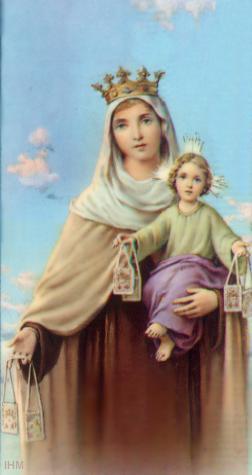
It was given by Our Lady of Carmen to St. Simon Stock in Aylesford, the outskirts of London, in 1251, with great promise by the Mother of God: "The one who dies with the Scapular, will not go to the fires of Hell".


You can't offer more for doing less!... things of a Mother!... I know it carries deep theological arguments... but the Mother of God should know!...


... The fact is that since 1251 all the Popes have ware the Scapular, including John Pope II, and the Cardinals, and Bishops, and priest and nuns, and millions and millions of faithful laymen...


Do you want to get an Scapular: Go to any Catholic Church and ask for it, that simple!... give it to your child and husband and wife and best friend... my mother gave it to me while a baby, and I still wear it, praise the Lord!.


The Medals of Mary:


It is another easy but efficient gift of the Mother of God and our Mother.


When Mary appeared in Paris to St. Catherine Labouré in 1830, she gave her Miraculous Medal... there were so many miracles with the Medal that in 5 years 10 million medals were distributed...


Try it!... Her rosary, her Scapular, her medal... easy things of a mother!... but very effective for earth and for Heaven... use them, even if you don't believe in them... I promise you will see wonders as I have seen them...


... And they are very modern objects, ask the hippies, the occultists, the New Agers... ask those who plan political campaigns, or the sport fans, or the movie goers....


... Anyway, use them, they cost you really nothing, and the day least expected you will find yourself in Heaven, giving a kiss to the Mother of God, who is your Mother!, praise the Lord!.

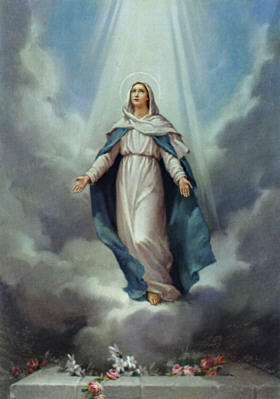
Dogma of the Assumption of Mary


Heaven.

The Assumption became a feast day celebrated by the Church every year. What it brings to mind is the height to which the Church has elevated this special woman. This revelation did not just occur to Pope Pius XII in 1950. Rather, his announcement made formal what had been believed for centuries. The beliefs about Mary go beyond assumption and include doctrines about her Immaculate Conception; she was born free from sin, her perpetual virginity and her action as co-redeemer with Christ.

Whereas non-Catholic Christianity tends to view the Bible as God’s last revelation to mankind, the Roman Catholic Church sees itself as an instrument of God receiving new revelations from the Holy Spirit. So this new revelation about Mary was confirmed in 1950 without a visible ripple. The doctrine of the Assumption fits right in to orthodox Catholic thinking.

The term “assumption” does not appear in the Bible but Enoch and Elijah went to be with God without experiencing death. Bishop Theoteknos of Livias (c. 550-650) was one Catholic theologian who believed that Mary, above all, deserved at least the same treatment. In his sermon he states:

"For Christ took His immaculate flesh from the immaculate flesh of Mary; and if He had prepared a place in heaven for the Apostles, how much more for His mother. If Enoch had been translated and Elijah had gone to heaven, how much more Mary, who like the moon in the midst of the stars shines forth and excels among the prophets and Apostles? For even though her God-bearing body tasted death, it did not undergo corruption, but was preserved incorrupt and undefiled and taken up into heaven with its pure and spotless soul."

So Mary is above and beyond anyone who ever lived with the exception of her son, Jesus. It is a firm belief among Catholics that from her conception, Mary was free of original sin, the sin that we all inherit from Adam. The angel Gabriel, in announcing to Mary her imminent pregnancy, called her “highly favored one” “the Lord is with you” and “blessed are you among women”. So Mary is chosen to be the mother of God incarnate, through a virgin birth by the power of the Holy Spirit.

No one knows exactly where, when or how Mary died. Apostolic Tradition Points to a time between three and fifteen years after the Ascension of Jesus. There are conflicting claims as to her place of death, either Jerusalem or Ephesus. There is a tomb of Mary in Jerusalem but it only became known after the sixth century AD. St. Juvenal, Bishop of Jerusalem let it be known in 451 that Mary died in the presence of all the Apostles. Her tomb was opened at the request of St. Thomas (did he doubt that she was there?) and found to be empty. The Apostles concluded that she had been taken up to Heaven, body and soul.

There are some apocryphal writings from the early church that mention the Assumption of Mary but most of these documents are flawed and suspect. There is a letter bearing the name of St. John which mentions Mary’s bodily assumption into Heaven but it has been dated to the fourth or fifth century AD. “De Transitu Virginis”, a letter falsely ascribed to St. Denis the Areopagite, also mentions it. Genuine writings from St. Andrew of Crete, St. John of Damascene and others also make mention of Mary’s bodily assumption. Sermons previously attributed to St. Jerome and St. Augustine that support the Assumption have been shown to be counterfeit.

The belief in Mary’s bodily assumption is universal in eastern and western Catholic Churches of today. Why wasn’t the Assumption a part of Catholic doctrine long ago? Why was it adopted so long after the fact? Catholic apologists say that the early Church had too many questions to resolve surrounding who Christ was and what He meant to us and did not have a particular set of doctrines to deal with Mary until many of the other questions were dealt with.

The Church evolved an entire theology surrounding Mary. She got new names: Blessed Virgin, Mother of God, Immaculate Mother, Queen of Heaven, Queen of Angels, among many others. The doctrine of The Immaculate Conception defines Mary as conceived without original sin and having lived a sinless life. She is the New Eve, perpetually a virgin. Through the Rosary, she is prayed to and Mary is sought as the intercessor between the faithful and Jesus. Would Jesus say no to his mother? At the wedding at Cana (John 2), Jesus obeyed his mother when she asked him to make wine.

All of these beliefs about Mary form the basis from which belief in the Assumption grew. Mary stood at the foot of Jesus’ cross when all of the disciples, save John, had fled. She was with the Apostles at Pentecost when the gift of the Holy Spirit was given. Mary shared in the most intimate details of Jesus life: His birth, life, death and resurrection.

Catholics generally believe, those that take the trouble to investigate it, that the promises of Christ as far as eternal life and resurrection of the body were fulfilled in Mary. If Mary was free of original sin, then she should not have had to suffer the consequences of that sin, namely, death. There is ongoing debate as to whether Mary ever died or was just “assumed” into God’s presence. If she died was that unjust? Did she share in Jesus bodily resurrection and glorification at her death?

The National Conference of Catholic Bishops said in their 1973 letter: "Behold Your Mother," "Christ has risen from the dead, we need no further assurance of our faith. Mary assumed into heaven serves rather as a gracious reminder to the Church that our Lord wishes all whom the Father has given Him to be raised with Him. In Mary taken to glory, to union with Christ, the Church sees herself answering the invitation of the heavenly Bridegroom."

At the heart of the belief in the Assumption is a deep unconditional love and devotion for Mary. Devotees have trouble accepting the fact that at her death her body would have suffered corruption in a grave. The reward for what she did and the role she played must be higher than the rest of us get and so, the Assumption is her reward as well as life everlasting with her Son, the Savior.

The Feast of the Assumption, celebrated August 15, every year is a reminder of the faith and obedience of Mary in saying “yes” to God. She and Joseph faithfully raised the young man Jesus so as to prepare him for ministry. She stood by him throughout his life and death and is receiving a just reward.

Saturday, September 03, 2005

Our Lady of the Miraculous Medal - Paris, France (1830)


In the summer of 1830, a 24 year old novice of the Sisters of Charity was awakened by a young child, about five years old, dressed in white who called to her:

"Catherine, Catherine, wake up. Come to the chapel; the Blessed Virgin is waiting for you."

Catherine Laboure, who had expressed a strong desire to meet the Blessed Virgin, decided to follow the child down to the chapel. The candles were burning as if at a midnight Mass. About a half-hour later, at midnight, she heard a noise that sounded like the rustle of a silk dress. When she looked up she saw a beautiful young woman surrounded by a blaze of white light sitting in the Father Director's chair. The child who brought her to the chapel told her: "Here is the Blessed Virgin!" Catherine fell to her knees and placed her hands on Mary's lap. Mary tod her:

"My child, the good God wishes to charge you with a mission. You will have much to suffer, but you will rise above these sufferings by reflecting that what you do is for the glory of God. You will know what the good God wants. You will be tormented until you have told him who is in charged with directing you. You will be contradicted, but do not fear, you will have grace. Tell with confidence all that passes within you. Tell it with simplicity. Have confidence. Do not be afraid."

During this discourse with the Blessed Mother, Catherine was warned of dire future occurrences. Mary told her:

"The times are very evil. Sorrows will befall France; the throne will be overturned. The whole world will be plunged into every kind of misery."

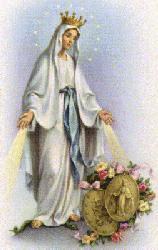
After this apparition Catherine had written down "in forty years" when referring to this prophecy. Five months later, in November, Catherine experienced another apparition. In this event Mary appeared dressed entirely in white holding a ball topped with a little golden cross. The ball, she was told, represented the whole world, especially France, and each person in particular. Mary stood on a white globe with a green serpent under her feet on the globe. After a moment, an oval shape formed around the Blessed Virgin, and on it were written these words in gold: `O Mary conceived without sin, pray for us who have recourse to thee.' Upon seeing this vision, Catherine heard a voice say: "Have a medal struck after this model. Those who wear it will receive great graces; abundant graces will be given to those who have confidence." At this point, the oval seemed to turn and Catherine saw the reverse of the medal: the letter M surmounted by a cross, and below it two hearts, one crowned with a crown of thorns, and the other pierced by a sword.

After hearing all of her accounts of these apparitions, her spiritual director, Father Aladel, still had doubts as to their veracity. He met with the local archbishop and after due deliberation the archbishop authorized that the medals be struck since he found nothing contrary to the Faith in anything Catherine said or experienced. Within months there were a flood of reported cures and spiritual conversions attributed to the medal; so much so that it came to be called the Miraculous Medal. Catherine went back to a life of obscurity in the Sisters of Charity once the medal had been fashioned and died in 1876. By the time of her death there were millions of Miraculous Medals being worn by the devout all over the world.

Our Lady Of Knock


County Mayo was in the center of a region of Ireland that had suffered great distress in the 1870's. Various famines and economic dislocations produced by forced evictions had created yet another wave of Irish immigration. It was into this environment that the Lord again sent His Mother to visit with His oppressed children.

August 21st, 1879 was another rain-swept day in County Mayo. As evening arrived, Margaret Beirne, a resident of the village of Cnoc Mhuire, was sent by her brother to lock up the local church for the evening. After she had completed this task, as she was returning home she noticed a strange brightness covering the church. However, preoccupied with other thoughts, she mentioned this to no one else.

At about this time, another member of the Beirne family, Mary, had just completed a visit with the church's housekeeper, Mary McLoughlin. As they were walking down the road they came to a location where they could clearly see the church and its gables, at which time Mary O'Beirne turned to her companion and said, "O look at the statues! Why didn't you tell me the priest had got new statues for the chapel?"

Her companion responded that she had heard nothing about new statues but she decided to look more closely. As they approached the church, Mary Beirne remarked, "But they are not statues, they're moving. It's the Blessed Virgin."

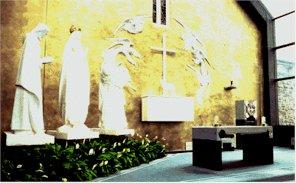
What they and thirteen others saw in the still-bright day was a beautiful woman, clothed in white garments, wearing a large brilliant crown. Her hands were raised as if in prayer. This woman was understood by all who saw her to be Mary, the Mother of Jesus and the Queen of the Angels.

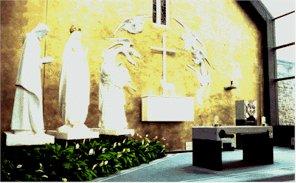
On her right stood St. Joseph, his head inclined towards her. On her left stood St. John the Evangelist, dressed as a bishop. To the left of St. John was an altar on which stood a lamb and a cross surrounded by angels. All of this was seen on the gable wall of the church in a cloud of light and lasted for about two hours. Other villagers, who were not involved with the apparition, nonetheless reported seeing a very bright light illuminating the area around where the church was located. There were subsequent reports of inexplicable healings associated with visits to the church at Knock.

The Church response to this series of events was typically circumspect. A commission was formed to gather testimonies of those claiming to see the apparition and then a record of purported cures and devotional material was maintained until 1936. At that time, the head of the diocese of Tuam, Archbishop Gilmartin, authorized the publication of a pamphlet supporting devotion to the apparition at Knock.

Our Lady Of Knock Had Largely Unknown Connection To Souls In Purgatory


By Susan Tassone

It was earlier this month that we celebrated the anniversary of a major Marian appearance. At about eight o’clock on the Thursday evening of the 21st of August, 1879, the Blessed Virgin Mary, St. Joseph, and St. John the Evangelist appeared at the south gable of the church at Knock, County Mayo, Ireland. Beside them and a little to the right were an altar with a Cross and the figure of a lamb, around which angels hovered.

There were fifteen official witnesses to the apparition -- young and old. They watched it for two hours in pouring rain and recited the Rosary. Today, Knock ranks among the world’s major Marian shrines with the full approval of the Church. Pope John Paul II visited the shrine on September 30, 1979, presenting the Golden Rose to this Shrine.

Not everyone is aware, however, that the marvelous appearance on the gable of the Knock Church came on the day when the parish priest, Archdeacon Cavanagh, finished offering, as he had promised, 100 consecutive Masses for the suffering souls in purgatory! A few months before the apparition the Archdeacon began to offer 100 Masses for the poor souls whom Our Lady wished most to release. It was on the day of the one hundredth Mass was offered Our Lady came to visit Knock.

Surely, that extraordinary devotion to the Holy Souls had a part to play in the gift of the vision from Heaven. If such a response came from Heaven to Archdeacon Cavanagh, then surely Our Lady wants to encourage us all to remove the torment of our dead. Our Lady is the mother of her children, above all her suffering children. She is the Refuge of Sinners on earth and in purgatory.

Indeed, we can dig deeper there for a link with our own day regarding this apparition. The reason the parish priest turned in this way to the Holy Souls was a painful problem similar to what affects many countries today. A secret organization resorting to violence had threatened the priest by letter for preaching against their tactics. They resented his condemnation of violence, which prevented them from gaining recruits in the Knock parish. In his distress, he turned to the suffering souls and called on his parishioners to fill the church for 100 days of these offered Masses. And what an answer he was given from Heaven!

This clearly tells us that the Holy Souls stopped the violence through Our Lady’s intercession at Knock. This applies to our day with the unspeakable violence and terrorist attacks around the world. Now is the time to act! Here are some powerful means to help:

I encourage you to ask a priest (perhaps one who is retired) to offer 100 Masses for the Holy Souls for the intention of world peace. We have done this in Chicago, Texas, and Philadelphia. Attend Mass and receive Holy Communion for 100 days. If that is not possible, offer 100 Masses (or four sets of Gregorian Masses) for the souls in purgatory for World Peace. Several people can go in together for the Mass stipend for these Masses. Visit our website at: www.spiritualtreasury.org for Mass Offerings and Gregorian Masses. Can you imagine the power we have to stop the violence and wars with the Holy Sacrifice of the Mass, fasting, and prayer!

Today, many are discovering how the Eucharist not only purifies the souls of those who have died but also heals the living as one deepens his relationship with Jesus.

A British psychiatrist named Dr. Kenneth McCall collected over a thousand cases of emotional or physical healing of clients when they offered a Mass for their deceased loved ones. The Mass heals the living and the dead!

The Holy Souls in purgatory are pleading for our Masses and prayers. The Mass is the greatest prayer to give the Holy Souls to behold the face of God! Make their desire your desire. St. John Chrysostom tells us, “Christ is the victim that gives solace to the dead.” And remember the priests and nuns in purgatory. We have only two months remaining during this historic Year of the Eucharist. Offer and attend Mass as much as possible for the priests and consecrated religious. Their intercession is very powerful.

A Holy Soul said the following: “You the living can do everything for us, and we can do everything for you. It is an exchange of prayers.”

Our Lady of Knock, pray for us!